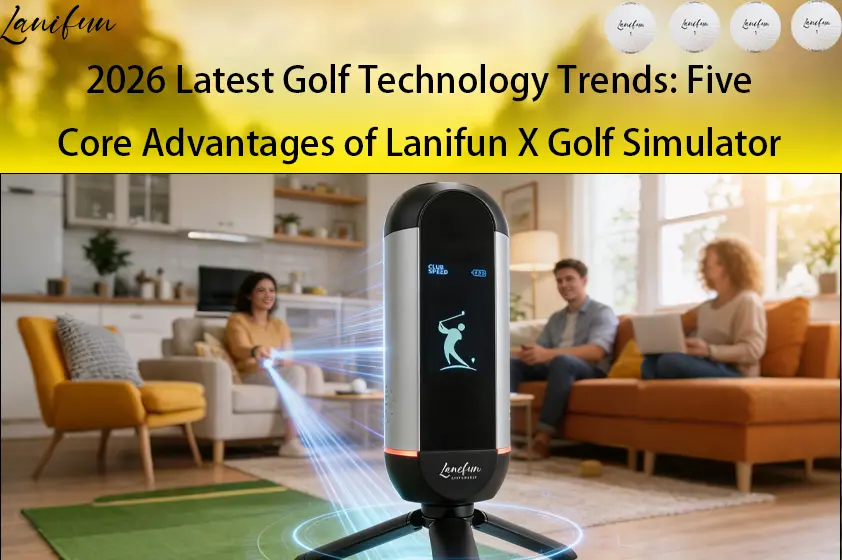

Chinese Golf Launch Monitor Manufacturers: A Complete Buyer's Guide
When selecting a Chinese golf launch monitor manufacturer, prioritize data verification and production line certification over the lowest price. Clearly define the specifications for speed and distance measurement, conduct hands-on testing with a prototype, and confirm the after-sales support policy.
Understanding the Basics: What It Is and How It Measures
Doppler radar systems emit microwaves and capture the echoes; they calculate ball speed based on frequency shifts and determine distance based on time—all without relying on ambient light. High-speed camera-based systems, by contrast, track movement between frames; while they can capture a broader range of parameters, they are highly sensitive to lighting conditions. We utilize 24GHz radar technology, which offers an optimal balance of stable speed measurement, power efficiency, and compact size.
Golf launch monitors designed for home use are easy to set up. Our “Lanifun X” model, for example, features 24GHz radar, Bluetooth 5.2/5.3 connectivity, a 3000mAh battery (providing approximately 6–8 hours of runtime), and Type-C charging.
> Our device employs 24GHz Doppler radar, with an officially rated speed measurement range of 32–220 mph (15–99 m/s) and a distance measurement range of up to 350m (385 yards). These specifications are documented in our official spec sheet, allowing buyers to verify them directly rather than relying on verbal promises.
5 Key Criteria for Evaluating Manufacturers
- Radar and Data: Confirm the frequency band and ensure that the speed and distance measurement capabilities are officially stated and included in the product specifications. Evaluate the accuracy of the golf launch monitor based on specific testing conditions. Clear, documented specifications make product acceptance straightforward.
- Production Lines and Quality Control: Verify whether the manufacturer owns their own production facilities and if they can facilitate a virtual factory tour (video inspection). In-house production ensures product consistency.
- Certifications and Market Compliance: Look for certifications such as UKCA (UK), CE/RoHS (EU), FCC (US), and ISO9001. For golf launch monitors exported from China, ensure that the certifications specifically cover the model in question; otherwise, you may face difficulties listing or selling the product.
- OEM/ODM Capabilities. Customization options include the startup logo/animation, pre-installed APKs, color schemes, packaging, screen printing, firmware, and interface configurations. The depth of customization determines the viability of the final product.
- Spare Parts and After-Sales Support. Establish a fixed ratio for spare parts inventory, ensure direct factory shipment for defective units, and define clear turnaround times. The availability of spare parts directly dictates potential equipment downtime.
5-Step Verification Checklist Before Placing an Order
- Request Specifications. Ensure that key metrics—such as a measurement range of 32–220 mph, an accuracy/range threshold of ≤350m, Bluetooth connectivity, and battery life—are documented as “official manufacturer specifications.” Verify all units of measurement and technical definitions.
- Request a Prototype for Field Testing. Test the device’s startup/shutdown process and data readings in your own backyard. For the Lanifun X, confirm the inclusion of a phone mount and tripod. Hit ten consecutive balls to evaluate consistency.
- Verify Certifications and Firmware. Check that the UKCA, CE, RoHS, and FCC certificates match the specific model. Lock in the firmware version based on your intended sales channel, and ensure the model numbers on the certificates align with those on the device itself.
- Confirm OEM Terms. The contract must explicitly detail the logo, color scheme, screen printing, and pre-installed apps, as well as included accessories (tripod, Type-C cable, and carrying case). Attachments should specify the exact logo design and color codes.
- Define the Spare Parts Process. Include the agreed-upon spare parts ratio and the timeline for direct factory shipment of replacements in the contract. Clearly outline the expected turnaround time for replacement shipments and provide an itemized list of included parts.
> Our golden rule for factory vetting: Always test a prototype before initiating mass production. Ensure the device connects and provides accurate readings in your specific environment, then finalize the firmware version and packaging—this prevents disputes before an order is even placed.
Four Real-World Usage Scenarios
Chinese Golf Launch Monitor for Backyard Practice
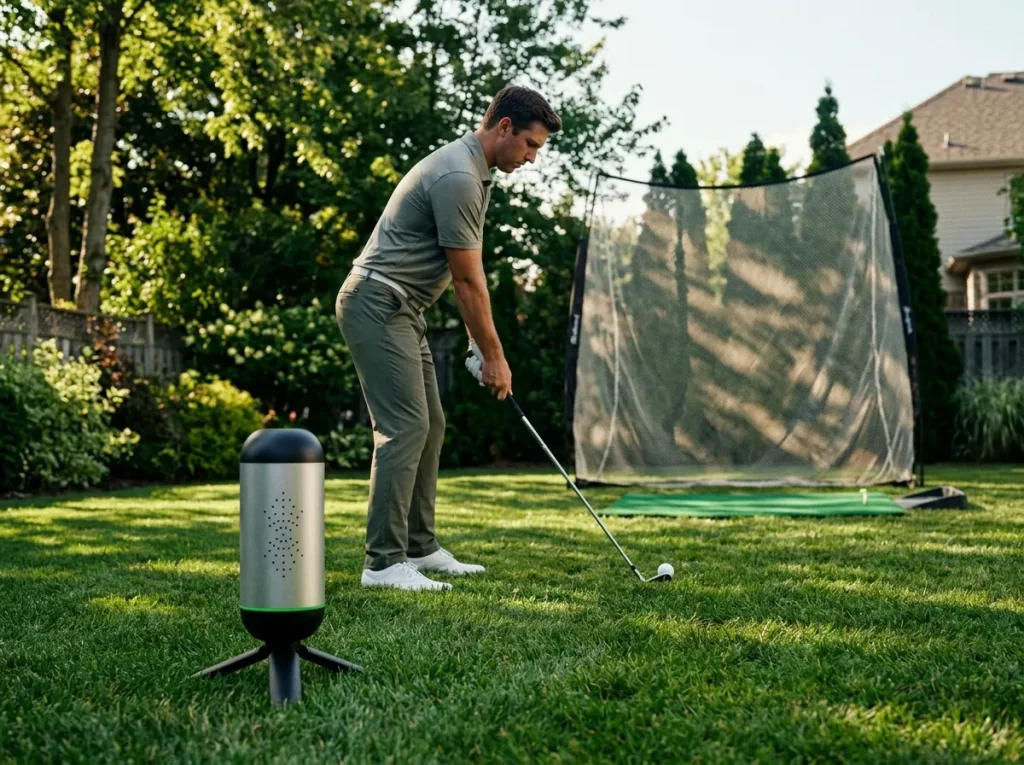
In a backyard with limited space, ensure a safe distance between the ball and the launch monitor, and avoid areas that might cause signal interference (echoes). We position the Lanifun X approximately 1.5 meters behind the hitting area; its green LED ring and vertical display make it easy to read data. The device supports range-style practice and screen recording, allowing you to review your swing afterward. Avoid placing it near highly reflective fencing. With an operating temperature range of -5°C to 50°C, it is suitable for use throughout most of the year in the UK. Ensure a two-meter buffer zone for your swing, and position the radar unit so it faces the direction of your shot.
Indoor Golf Simulators
For indoor setups, first verify software compatibility and screen requirements. The device supports 3D virtual course simulations and integrates with mainstream simulator software. If choosing a golf launch monitor with an app, test the Bluetooth connection stability first. In smaller rooms, place the device against a wall and use the built-in tripod—no need for an additional stand. If you only need to review data, a screen isn’t strictly necessary; however, for a fully immersive course experience, a projector is recommended. Ensure the room has a depth of at least three meters, and use soft floor mats to dampen echoes.
Driving Range Sessions
At busy driving ranges with spaced-out hitting bays, the value of a portable golf launch monitor lies in its mobility. Simply carry it to your bay in its storage case; it charges via a Type-C cable and offers 6–8 hours of battery life—plenty for an entire afternoon. For precise range training, be mindful of the spacing between bays; ensure that balls from adjacent lanes do not enter the radar’s detection zone, as this ensures cleaner, more stable data readings. Try to visit during off-peak hours and maintain a two-meter gap from neighboring bays to minimize interference.
Garage and Travel Setups
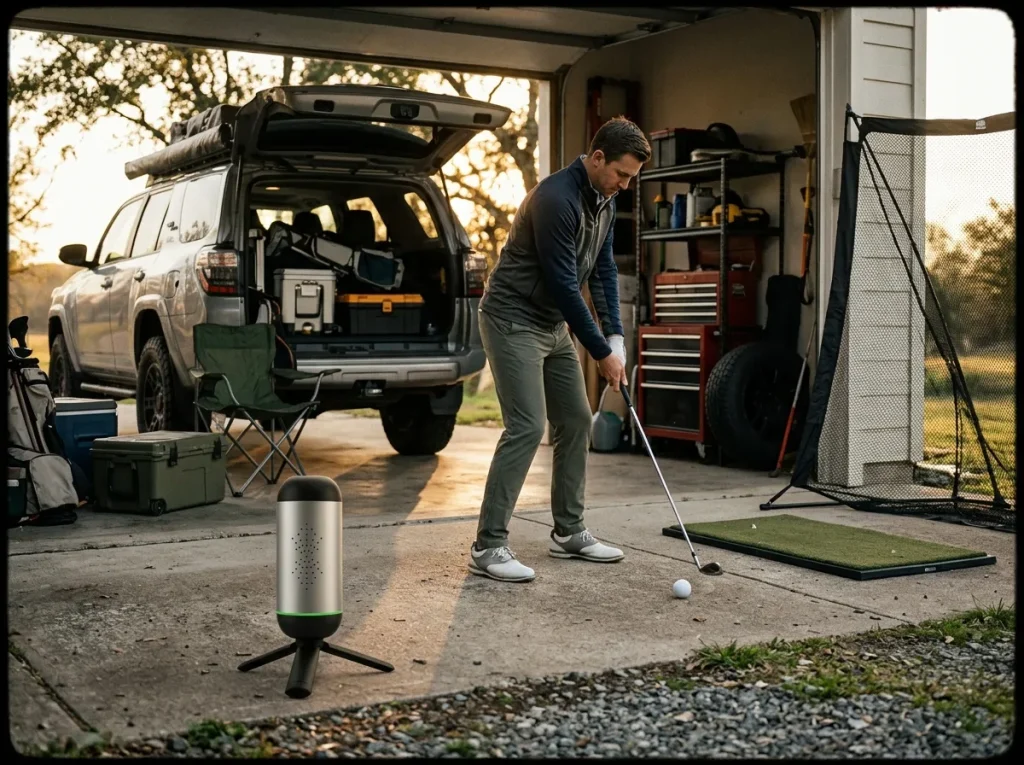
For garage use or travel, the focus is on compact storage and quick setup. The device comes with a tripod and a phone mount (since it lacks a magnetic base, it must be placed on a flat surface or a tripod), allowing for instant use. You can also pair it with our 32-inch mobile smart screen (featuring Android 14, an RK3576 processor, and a 14.8V 15,000mAh battery) for a larger display. The primary distinction between a standalone launch monitor and a full golf simulator setup is the inclusion of a screen. Before packing up, double-check all cables, and be sure to follow airline regulations regarding lithium batteries when traveling.
About Us: Lanifun’s Manufacturing and Customization Capabilities
We are Lanifun. We operate our own production lines for portable golf launch monitors and 32-inch mobile smart screens. We offer comprehensive OEM/ODM services, including custom branding (logos, color schemes, packaging, and screen printing), firmware and interface customization, and channel-specific firmware version locking. We provide prototypes before moving to full-scale production, maintain a supply of spare parts based on order volume, and handle replacements directly from our factory. Certifications: UKCA/CE/RoHS (UK), FCC (USA); Quality Management System: ISO9001.
> Based on our experience in the UK market, the earlier a buyer incorporates specific certifications, firmware versions, and spare parts ratios into the contract, the less rework is required upon arrival. Customization is not just a marketing slogan—it is a set of technical parameters explicitly defined in the production order.
FAQ
Q: How should a beginner choose a device?
A: First, determine the intended use—backyard, indoors, or a driving range—and check the specifications for ball speed and distance measurement accuracy. Always request a sample unit for hands-on testing before discussing customization. Ensure that the “officially stated” performance figures are documented in writing, and do not rely solely on vague, qualitative descriptions of accuracy.
Q: Can it be used in a small backyard?
A: In most cases, yes. The key is to maintain the required distance between the ball and the device, and to minimize signal reflections (echoes) from walls. We recommend placing the Lanifun X behind the hitting position and securing it on a tripod. Test the stability of the readings first, then decide whether a hitting net is necessary.
Q: Is a projection screen required for indoor use?
A: It depends on whether you want simple data feedback or an immersive virtual course experience. For basic range-style practice, a vertical screen paired with a mobile app is sufficient; for a 3D virtual course, you will need a projection screen and a projector. The system supports screen recording and sharing—test the Bluetooth stability before making a full investment.
Q: What if the Bluetooth won't connect?
A: Ensure the device (using Bluetooth 5.2/5.3) is not already connected to another terminal. Restart the unit, move it within 2 meters of your phone, and attempt to pair again. If it still fails, use the official 2.4GHz/2Mbps high-speed channel to troubleshoot or export data. Such issues are covered in our multilingual user manuals, and our factory team can provide remote guidance.
Q: Is the battery life sufficient?
A: The device features a 3000mAh battery, providing approximately 6–8 hours of runtime—enough for a full practice session or half a day at the driving range. It can be recharged via a Type-C port. The operating temperature range is -5°C to 50°C (note that battery performance may slightly decrease in cold temperatures). Ensure that battery life specifications are included in your documentation rather than relying on verbal promises.
Key Takeaways
When selecting a Chinese manufacturer for golf launch monitors, verify these 6 points:
- Evaluate the manufacturer (e.g., Lanifun) based on technical data, production lines, and certifications—not just the quoted price.
- Ensure the device features 24GHz radar technology, with a specified speed measurement range of 32–220 mph and a distance measurement range of up to 350m.
- Follow a 5-step process: request technical specifications → conduct hands-on testing with a prototype → verify certifications and firmware → finalize OEM arrangements → secure a supply of spare parts.
- Placement requirements vary by usage scenario; always validate with a prototype first.
- Proceed to full-scale production only after prototype validation; maintain an appropriate ratio of spare parts, with the factory handling direct shipment of replacements for any defective units.