Lanifun X vs. Multi-Brand Golf Launch Monitors: A Comparative Analysis—How to Choose the Best Golf Radar for You?
For today’s golfers, instructors, and club fitters, the Golf Launch Monitor is no longer a luxury item, but rather an essential tool for technical improvement. Whether analyzing swing data, performing digital club fitting, or enjoying the thrills of indoor golf simulation, an accurate and reliable launch monitor plays a pivotal role.
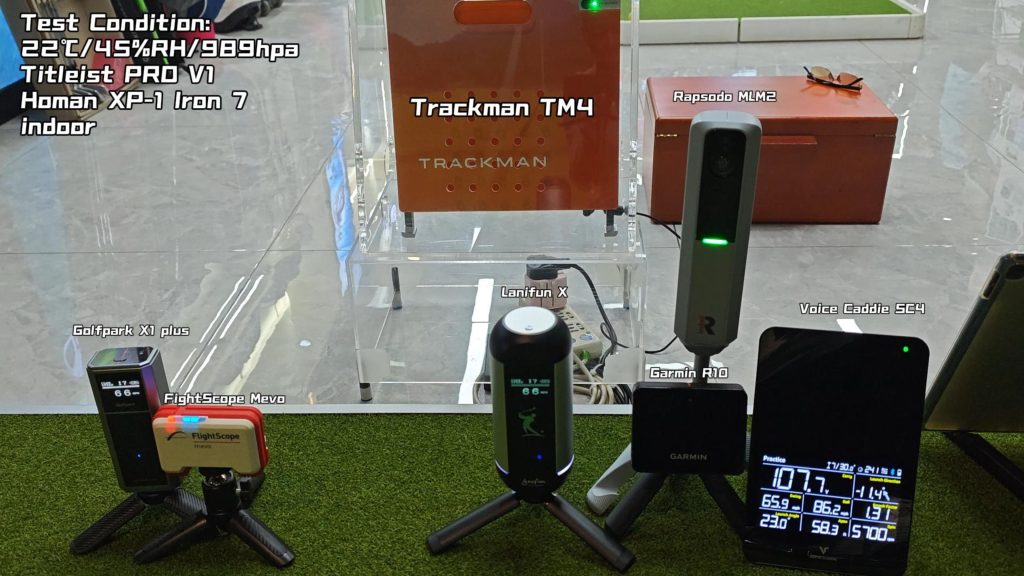
Amidst the vast array of products available, how does one choose the device that best suits their needs? Today, using the industry benchmark—the Trackman TM4—as our standard, we will conduct an in-depth comparison of the six most popular golf launch monitors currently on the market, with a particular focus on dissecting the real-world performance of the up-and-coming Lanifun X. Through a multi-dimensional analysis covering data accuracy, missed-shot rates, and stability (CV values), we will unveil the secrets hidden within these “black boxes.”
Core Parameter Comparison Overview
Before diving into a detailed analysis, let’s first use a comparison table to visually assess how each brand’s performance deviates relative to the industry’s “gold standard”—the Trackman TM4. (To ensure reliability and authenticity, this data was derived from a continuous, unedited sequence of shots—verified by video footage—to test each product’s operational fluidity and data response speed. All data was subsequently fed into Deepseek for AI-driven intelligent analysis and evaluation.)
Brand/Model | Missed Shot Rate | Ball Speed Deviation | Spin Deviation | Overall Stability (CV Value) | Core Strengths |
|---|---|---|---|---|---|
Trackman TM4 | 0% | Baseline (0%) | Baseline (0%) | Extremely High | Industry Benchmark; All-Around Performer |
Lanifun X | 0% | +2.0% | -4.9% | Moderate | Excellent Spin Performance; Comprehensive Data |
Garmin R10 | 0% | +0.7% | +2.4% | High | Overall Performance Closest to Baseline |
Rapsodo MLM2 | 59% | +0.47% | Highly Variable | Low | Intuitive Distance Feedback |
Flight Scope Mevo | 8.3% | +1.16% | +26.5% | High | Accurate Basic Ball Speed |
Golfpark X1 Plus | 0% | <±2% | <±2% | Moderate | Precise APEX (Max Height) Capture |
Note: Significant deviations in club speed may be attributed to differing definitions of the measurement point (e.g., peak club speed vs. club speed at impact).
The Industry Gold Standard: Trackman TM4
When discussing any golf launch monitor, the Trackman TM4 is an unavoidable topic. As the globally recognized industry benchmark, Trackman delivers unparalleled data stability thanks to its advanced 3D Doppler radar technology.
Pros: It boasts the lowest CV (Coefficient of Variation) values across all metrics, signifying extremely stable data with high repeatability. Its missed-shot rate is strictly 0%, ensuring that every single swing is faithfully recorded.
Cons: The price point is prohibitively high; primarily targeting elite club-fitting studios, tour coaches, and high-net-worth players, it is destined to remain outside the mass market.
Benchmark Significance: In this comparison, we will use data from the Trackman TM4 as the “true value” against which we measure the deviation rates of all other devices.
Multi-Dimensional Comparison: Who Can Challenge the Benchmark?
1. Rapsodo MLM2: The Darling of Distance, the Outcast of User Experience
Thanks to its radar technology—which shares its lineage with baseball analytics—the MLM2 has carved out a niche for itself in the market.
- Data Performance: It exhibits minimal deviation from the Trackman in terms of ball speed and clubhead speed (+0.47% and +3.47%, respectively). Its Carry distance is slightly higher than the Trackman's (+3.4%), a feature that holds immense appeal for golfers whose primary concern is simply, "How far can I hit it?"
- Fatal Flaw: An alarmingly high missed-shot rate of 59%. This means that out of every 10 shots hit, nearly 6 fail to be effectively captured. This disjointed user experience renders it unsuitable as a tool for serious training.
- Conclusion: While its data algorithms show promise, the device's fundamental shortcomings in hardware capture capabilities significantly drag down its overall score.
2. FlightScope Mevo: The Ace of Clubhead Data, the Underachiever in Spin Data
The FlightScope Mevo series has garnered attention for its portability and its unique 3D Doppler technology.
- Data Performance: It manages deviations in clubhead speed and ball speed very well (+6.6% and +1.16%), boasts a low missed-shot rate (8.3%), and demonstrates good data consistency. For beginners focused primarily on clubhead speed, it appears to be a solid choice.
- Shortcomings: Its data for Apex (trajectory peak) and Spin exhibits massive deviations (+30.5% and +26.5%). In golf, spin is the critical factor governing shot dispersion and trajectory; such inaccuracy in this core metric renders its flight predictions virtually useless.
- Recommendation: Unless you are completely indifferent to the actual flight path of the ball through the air, the Mevo requires a major overhaul of its core algorithms.
3. Garmin R10: The All-Rounder—Closest to the Benchmark
Leveraging its extensive technical expertise in outdoor navigation, Garmin’s R10 became an instant hit upon its release.
- Data Performance: It boasts a 0% missed-shot rate, ensuring complete data integrity. Deviations across various metrics compared to Trackman are minimal: Club Speed is +2.87%, Ball Speed is +0.7%, and Carry Distance shows a deviation of a mere -0.39%. Data stability is excellent (indicated by low CV values).
- Areas for Improvement: The deviation in Apex height is slightly high (+14.6%), and Total Distance appears somewhat conservative (-3.0%).
- Overall Assessment: As a portable golf launch monitor, the Garmin R10 delivers overall performance that comes closest to matching Trackman among its peers, offering exceptional value for money.
4. Voice Caddie SC4: Accurate Distance, Fuzzy Details
The SC4 has won the favor of amateur golfers thanks to its built-in display and user-friendly design.
- Data Performance: Data is complete, with a 0% missed-shot rate. Total Distance shows virtually no deviation compared to Trackman (+0.66%).
- The Catch: Ball Speed readings are on the low side (-0.66%), and Carry Distance is underestimated (-3.0%). The deviation in Apex height is significant (-10.6%).
Although the Total Distance appears accurate, it is essentially a result “pieced together” from inaccurate trajectory and ball speed data, offering limited utility for advanced analysis.
5. Golfpark X1 Plus: The Hidden Gem of Accuracy
In this comparative analysis, the Golfpark X1 Plus demonstrated astonishing consistency.
- Data Performance: Data is complete, with a 0% missed-shot rate. Key metrics—including Ball Speed, Carry Distance, Total Distance, and Spin Rate—all fall within a ±2% deviation range relative to Trackman. Furthermore, its Apex height deviation (-4.1%) is the lowest among all competing products tested.
- Limitations: Club Speed deviation is relatively high (+6.9%), which may be attributed to how the device defines its measurement point.
- Overall Assessment: This device delivers overall performance that rivals the very best—coming remarkably close to Trackman—and is highly recommended.
The Emergence of the Lanifun X
As the central subject of this analysis, the Lanifun X showcases a distinct and unique approach to technical calibration. Rather than blindly chasing benchmarks, it has surpassed them in several key metrics, carving out a unique path for itself within the golf launch monitor market.
Core Strengths of the Lanifun X
1. Industry-Leading Spin Accuracy
Among golf data points, “Spin” is one of the most challenging metrics to measure, yet it directly influences a ball’s launch angle and subsequent roll-out upon landing. Data indicates that the Lanifun X exhibits a spin deviation of just -4.9%.
Comparative Significance: This performance far exceeds that of the FlightScope Mevo (+26.5%) and even outperforms the Garmin R10 (+2.4%) and Voice Caddie SC4 (+3.35%). For golfers who prioritize attacking the green and stopping the ball effectively, the spin data provided by the Lanifun X offers invaluable insights.
2. A Complete Data Stream with Zero Missed Shots
In stark contrast to the Rapsodo MLM2’s high missed-shot rate of 59%, the Lanifun X boasts a 0% missed-shot rate. This means that every single swing—whether a massive slice or a perfectly straight shot—is faithfully recorded. For coaches and players who rely on large data samples for training, data integrity is the foundational step in building trust.
3. Precise Ball Speed Capture
The Lanifun X’s ball speed reading deviates by only +2.0% compared to Trackman, placing it in the top tier alongside devices like the Garmin R10 (+0.7%) and Golfpark X1 Plus (+1.2%). This demonstrates that its radar or camera sampling rate is highly accurate in capturing the instantaneous moment of impact.
Technical Analysis and Optimization Suggestions for the Lanifun X
The “Misunderstanding” Regarding Club Speed Deviation: Data indicates that the Lanifun X exhibits the largest deviation in club speed (+8.1%). This likely stems from a difference in measurement principles. Trackman typically measures club head speed at the precise moment of impact, whereas the Lanifun X may be measuring the “maximum speed achieved between the top of the backswing and the moment of impact.” While technically justifiable, this distinction can easily lead to misunderstandings among users unfamiliar with the underlying principles.
Fine-Tuning of Distance Algorithms: The “Carry” and “Total” distance readings appear slightly lower than benchmarks (-0.67% and -2.36%, respectively). Given the precision of its spin data, the slight discrepancies observed may stem from a conservative approach to modeling atmospheric drag and post-landing roll. For players who demand absolute data consistency, these parameters may be further refined through future software updates.
Golf Launch Monitor Buying Guide: Frequently Asked Questions (FAQ)
Q1: Why do different devices yield different clubhead speed readings?
A1: This typically depends on which specific part of the clubhead the radar is tracking. Some devices capture the geometric center of the clubhead, whereas devices like the Lanifun X focus on capturing the peak velocity achieved along the swing path.
Q2: How does a high miss-read rate impact training?
A2: A high miss-read rate (such as that seen in the Rapsodo MLM2) disrupts the rhythm of a training session, making it difficult to compile a comprehensive and effective training log. For serious players, we recommend prioritizing devices with a zero miss-read rate—such as the Lanifun X.
Q3: Is accuracy important in a golf launch monitor?
A3: Accuracy is a relative concept. For 90% of amateur golfers, data consistency is far more important than absolute accuracy. As long as a device’s margin of error remains constant from shot to shot, it can effectively assist you in fine-tuning your swing.
Summary and Buying Guide
The arrival of the Lanifun X proves one thing: in the realm of golf launch monitors, newcomers can indeed surpass industry giants—at least in specific technical areas—by deeply specializing in key technologies (such as spin algorithms). For data enthusiasts and tech aficionados, the Lanifun X’s focused and deliberate approach to calibration—prioritizing certain metrics while making calculated trade-offs elsewhere—may just make it the most intriguing device currently available on the market.
If you are looking for a launch monitor that reliably captures data for every single shot—and places a high priority on the precise analysis of spin dynamics—the Lanifun X is undoubtedly a contender worthy of a spot on your shortlist.